
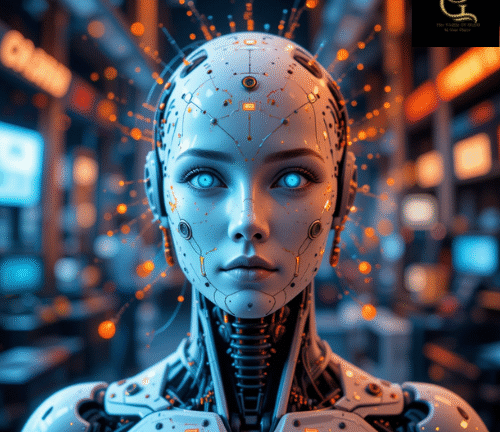
Agentic AI: Ushering in the Next Era of Autonomous Intelligence
The art of artificial intelligence (AI) is changing dramatically. For years, AI systems have been mostly passive tools—executing commands, helping process data, and streamlining operations. But in 2025, a new generation of AI is quickly appearing: Agentic AI. These systems are more than just helpful—they act. They plan, reason, decide, and take action. They’re not tools; they are agents.
Agentic AI marks a paradigm shift in AI. Instead of being constantly prompted by humans, agentic AI has the ability to work semi-autonomously or fully autonomously to achieve multi-domain complex tasks in areas of business operations, customer service, logistics, software development, and more.
What is Agentic AI
Agentic AI systems are characterized by their ability to act autonomously towards achieving a goal. They sense their surroundings, reason in context, decide, and act—oftentimes without continuous human intervention. Agentic AI incorporates several AI capabilities into a unified whole:
Natural language generation and understanding
Contextual reasoning
Multi-step planning
Real-time decision-making
Memory and self-awareness
Task execution using APIs or tools
In contrast to standard narrow AI models that execute specific instructions or respond in a vacuum, agentic AI can dynamically chain together tasks to accomplish a more general goal. A simple example: rather than only summarizing a report when instructed, an agentic AI might be instructed to “launch a product,” and it would look up competitors, write emails, generate documents, schedule timelines, and even interact with teams via APIs or integrations.
Key Elements of Agentic AI
Agentic AI systems have some core elements in their architecture:
Goal-Directed Behavior
Agentic systems work towards stated goals. Whether running a campaign or addressing a customer complaint, they decompose goals into sub-tasks and work on them sequentially or in parallel.
Planning and Tool Use
These AIs are able to determine tools to use (e.g., code interpreters, browsers, APIs), create multi-step plans, and modify those plans appropriately based on feedback or failures.
Memory and Reflection
Memory allows agentic AI to remember previous interactions, choices, or actions and use them to build on prior knowledge. Advanced systems may incorporate self-reflection modules that compare performance and improve future approaches.
Environment Interaction
In contrast to static models stuck in chat interfaces, agentic AI can engage with digital worlds—sending messages, generating documents, or activating automation through interfaces such as Zapier, APIs, or webhooks.
Applications Across Industries
The possible uses of agentic AI are immense and quickly growing:
- Enterprise Automation
Businesses are employing agentic AI to process multi-step workflows, including customer service tickets, hiring employees, processing invoices, and creating reports. These applications cut down the amount of manual input, hastening business processes while reducing expenses. - Software Engineering
Agentic AI tools such as GitHub Copilot X or Replit Ghostwriter are becoming coding agents capable of writing, debugging, testing, and deploying code on their own. With a task such as “Build a simple weather app,” these agents can write UI, access APIs, and deploy the app—all with little human intervention. - Customer Service
Conversational agents are getting more sophisticated and able to handle complete conversations on different channels. They differ from the older chatbots in that they can think through problems, escalate as needed, and auto-follow up. - Marketing and Sales
AI agents now have the ability to research prospects, create personalized outreach, real-time campaign optimization, and even competitive trend analysis. AutoGPT or Salesforce’s Einstein Copilot are some early examples of this movement. - Scientific Discovery and Research
In scientific disciplines, agentic AI is employed to carry out literature reviews, form hypotheses, model experiments, and interpret findings. For instance, Google’s AlphaFold, not necessarily agentic itself, established the groundwork for autonomous systems that may one day plan and carry out biological studies.
Risks and Challenges
The potential of agentic AI is great, as are the risks. Autonomy and sophistication of these systems create new challenges:
Misalignment of goals: If an agent misinterprets an objective, it could perform harmful or undesired actions.
Over-reliance: Outsourcing complicated tasks to AI without monitoring may create blind spots in decision-making or diminish important human intervention.
Security: With the opening of access for agents to tools and systems, making sure that they cannot be exploited or hijacked becomes critical.
Transparency: Knowing why an AI made a decision—particularly if there were many steps and tools involved—can be tricky, leading to concerns around accountability.
The Future of Work with Agentic AI
With maturity of agentic AI, its boundaries will more likely shift various jobs. Many routine, repetitive jobs will get more automated with time, letting human beings take care of creative, strategic, and empathetic tasks. And most importantly, the collaboration of humans and AI agents will be a norm such that humans plan and prioritize tasks, and the agents carry out the details.
Others equate the rise of agentic AI with the dawn of cloud computing—a hidden but powerful infrastructure that changes the way work is accomplished. Others view it as the natural next step for AI, from intelligence to action.
Conclusion
Agentic AI is at the leading edge of artificial intelligence innovation. Through the integration of decision-making, autonomy, memory, and tool use, it represents a revolutionary shift away from static chatbots or reactive systems. This new generation of AI has the potential to transform industries by automating sophisticated tasks and allowing machines to act with intent.
But this potential will have to be responsibly captured. Developers, companies, and regulators will have to collaborate so that agentic AI systems remain secure, aligned, and responsible. If approached properly, agentic AI would turn out to be the biggest disruptive technological innovation of the decade—enabling humans and machines to collaborate hand in hand, not merely mind, but collaborative intent.



One thought on “Agentic AI: The Rise of Autonomous Intelligence”