
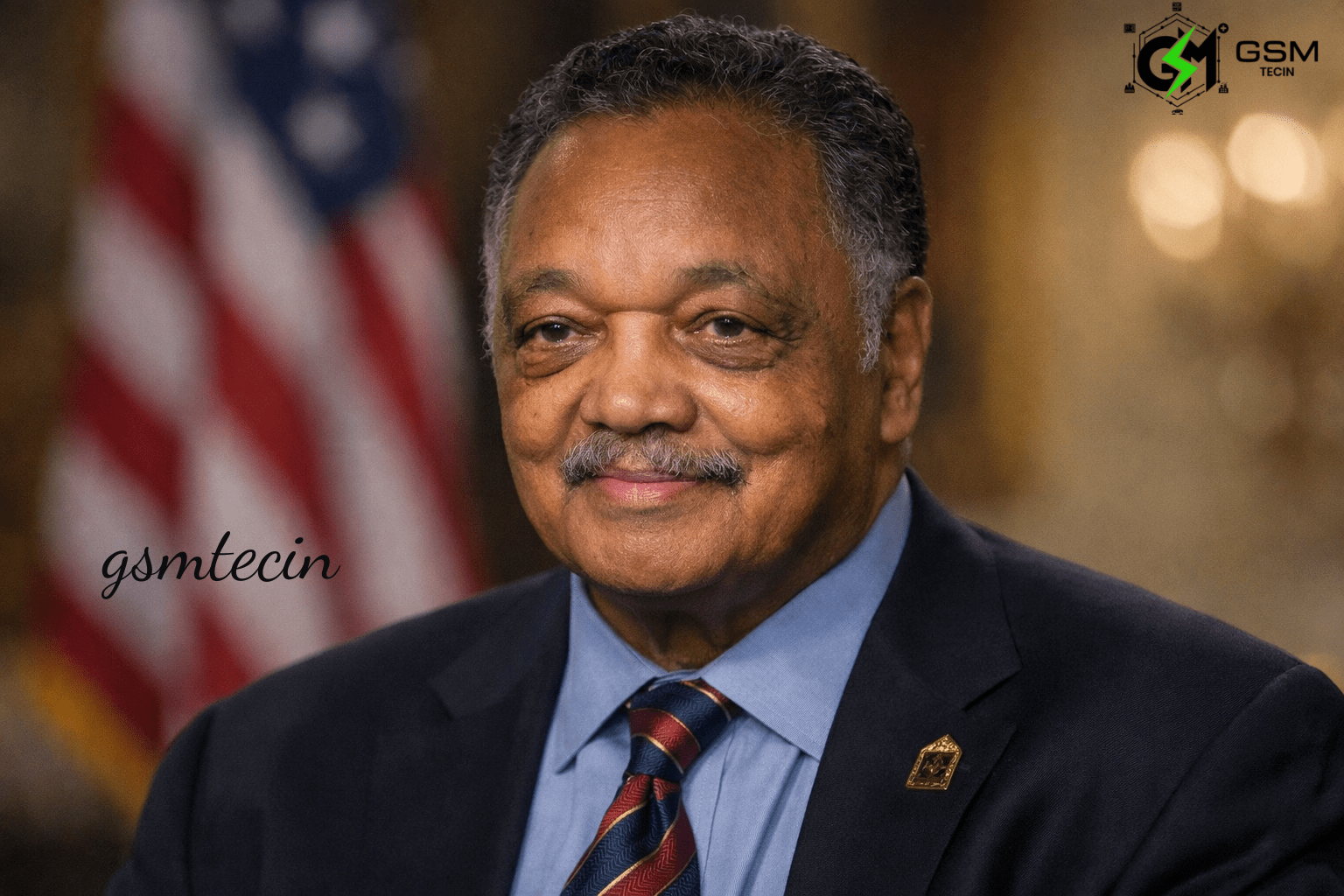
Jesse Jackson Dies at 84: A Life Dedicated to Justice
The death of Reverend Jesse Jackson, who played a major role in the American civil rights movement, occurred at 84 years old, according to a family announcement. The Jackson family described him in a statement as a “servant leader” who dedicated his life to protecting his family and “the oppressed, the voiceless, and the overlooked around the world.” The supporters should continue fighting for justice and equality and love to honor his legacy.
Jackson dedicated his life to Baptist ministry and activism while his voice continued to reach people throughout different time periods. His work included civil rights initiatives and political activities and diplomatic efforts and worldwide human rights work.
Early Life and Entry into the Civil Rights Movement
Jackson was born on October 8,1941 in Greenville South Carolina and spent his childhood in the racially divided American South. His mother Helen Burns raised him and he witnessed the effects of racial prejudice on his life. Despite the obstacles he faced, he achieved success in both academics and sports, which earned him a football scholarship to the University of Illinois, but he later transferred to North Carolina A&T State University, which is a historically Black college.
The 1960s saw Jackson dedicating himself entirely to the civil rights movement. His life transformed when he encountered Martin Luther King Jr. because King taught him the principles of nonviolent resistance which he applied to his activism work. Jackson became a member of the Southern Christian Leadership Conference (SCLC) where he developed into an effective organizer who also delivered powerful speeches.
Working Alongside Martin Luther King Jr
Jackson executed various voter registration programs and economic empowerment initiatives and grassroots organizing projects under King’s direction. He led Operation Breadbasket, an SCLC initiative that pressured businesses to hire African Americans and invest in Black communities.
Jackson was present at the Lorraine Motel in Memphis on April 4, 1968, when King was assassinated. The tragedy marked a pivotal moment in his life. Jackson expanded his activism throughout the United States to fulfill his mission of preserving King’s legacy.
Founding Operation PUSH and the Rainbow Coalition
Operation PUSH together with the Rainbow Coalition was established by Jesse Jackson. Jackson established Operation PUSH in 1971 to operate from Chicago with a mission to fight for civil rights and create economic opportunities and improve educational opportunities. He started the National Rainbow Coalition in 1984 which united various communities including African Americans and Latinos and working-class whites and farmers to pursue their common goals of justice and equality. The two organizations eventually merged to form the Rainbow PUSH Coalition.
His “Rainbow Coalition” concept emphasized unity across racial, ethnic, and economic lines because he believed that progress required broad-based solidarity. The concept of his Rainbow Coalition required different ethnic groups and diverse economic backgrounds to unite as one people.
Presidential Campaigns throughout History
Jesse Jackson made history as the first American politician to compete for the Democratic presidential nomination when he ran his first presidential campaign in 1984 and continued with his second campaign in 1988. The Democratic Party selected him as their presidential candidate for his first nationwide campaign which he launched in 1983.
Jackson lost the nomination when he lost party support to Walter Mondale in 1984 but his campaigns created excitement that attracted millions of voters. His 1988 presidential campaign achieved greater success than his previous election efforts when he won multiple primaries and caucuses which showed that minority and progressive voters had increased political strength.
Jackson used his election campaigns to support universal healthcare and voting rights and fair housing rights and worker protection rights and his opposition to South African apartheid. His activities created new opportunities for political engagement which resulted in improved representation of underrepresented groups in government positions.
International Diplomacy and Global Advocacy
Jackson worked on international missions which extended beyond his domestic political activities. He served as special envoy to Africa during the 1990s under President Bill Clinton. He participated in negotiations to free hostages from various countries including Syria and Cuba and Iraq and Serbia.
Jackson used his diplomatic work to show his dedication to protecting human rights and resolving conflicts. He positioned himself as a global advocate for peace and justice.
Health Challenges and Continued Activism
In 2017, Jackson revealed that doctors had diagnosed him with progressive supranuclear palsy (PSP), which medical experts consider a rare neurological disorder. He kept working in public life even though his health condition continued to worsen.
He took part in protests against racial injustice which included his involvement in the Black Lives Matter movement. Jackson told his supporters at a Minneapolis protest about George Floyd’s killing that they would not achieve victory through their efforts because they would face continued challenges despite their successful attempt to win. The people who commit violent acts against us need to stop their actions because it endangers our children who need protection. The people who believe will continue to exist.
He demonstrated his ongoing activism when he attended the 2024 Democratic National Convention in Chicago and participated in a City Council meeting which supported a ceasefire resolution for the Israel-Hamas conflict.
A Lasting Legacy
Jackson received both public admiration and public disapproval throughout his professional life. His political activities which he conducted through his direct communication methods created divided public opinions about his work. His supporters and his opponents recognized his contributions which shaped American political debate and advanced civil rights progress.
Jesse Jackson established permanent American historical presence through his Martin Luther King Jr. march and his presidential campaign work and his international peace advocacy. His dedication to fighting for equal rights and human dignity and job opportunities lasted for several decades which resulted in inspiring millions of people.
As tributes pour in, Jackson serves as a bridge between activism generations because he represented hope while challenging America to fulfill its fundamental principles.